
How to solve a 4x4 Rubik's Cube
Updated 2026-11-28 · by the Magic Cube team
You solve a 4x4 by turning it into a 3x3: first build the six centers, then pair up the edges, then solve it like a 3x3 with outer-layer turns only. This is called the reduction method. On top of the 3x3 you need one algorithm to pair edges and two for the parity cases, which happen only on even cubes.
You need to be able to solve a 3x3 already, with the beginner method or CFOP.
What is different on a 4x4
A 4x4 has 8 corners, 24 edge pieces (two per edge) and 24 center pieces (four per face). The corners behave exactly like on a 3x3. The centers and edges are what you solve first, so that each 2x2 center block acts like one 3x3 center and each edge pair acts like one 3x3 edge.
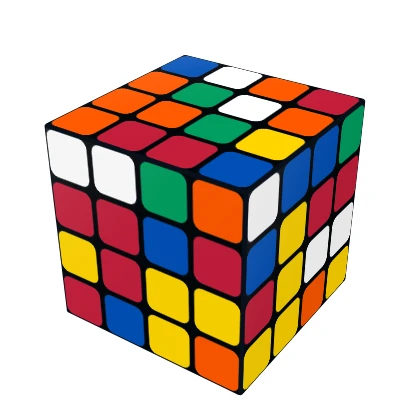
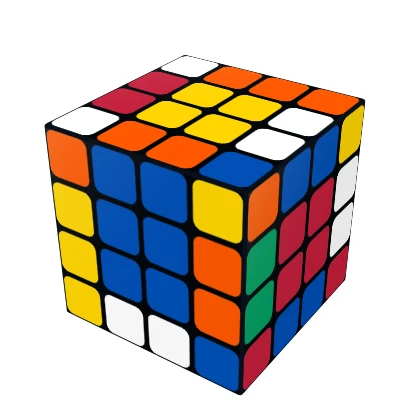
There is one big catch: a 4x4 has no fixed centers. On a 3x3 the centers tell you which color goes where. On a 4x4 you decide that yourself, and you can get it wrong.
Moves on a 4x4
Besides the usual R, U, F and so on, a 4x4 has moves that turn inner layers:
- Rw (also written r) turns the two right layers together.
- 2R turns only the second layer from the right.
- Uw, Fw, Lw and the others work the same way on their sides, as do 2L, 2U and so on.
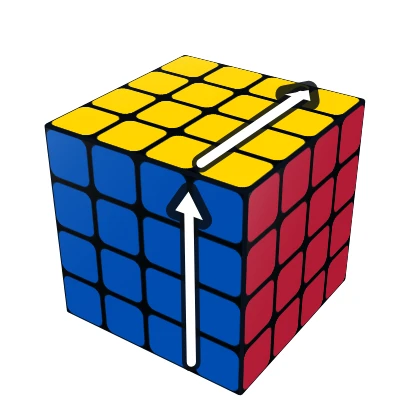
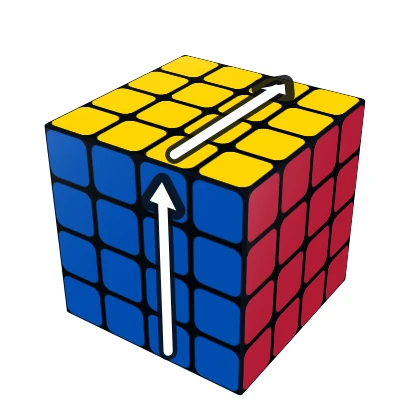
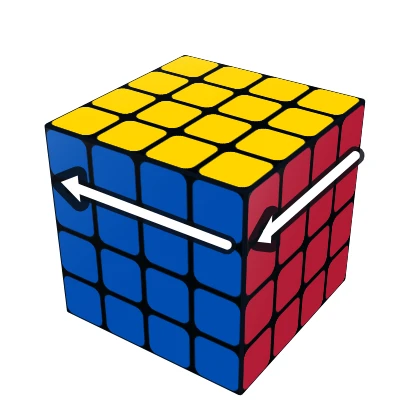
The notation guide explains every move.
Step 1. Centers
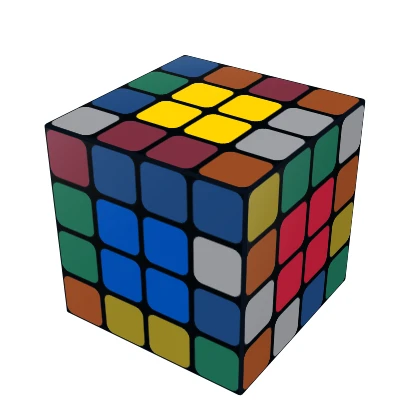
First center
Pick a color, for example white, and hold it on top. Make bars of two white center pieces on the other faces and bring them up next to each other. A wide turn like Rw brings a whole column of the front center up to the top. Before you do it, turn the top so the white bar that’s already there is out of the way.
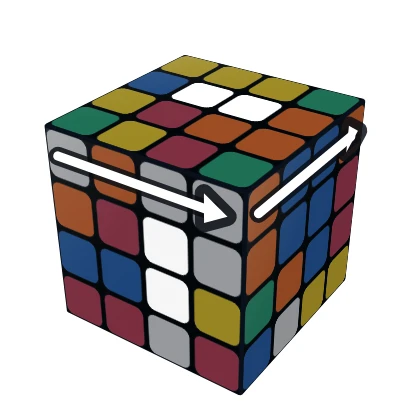
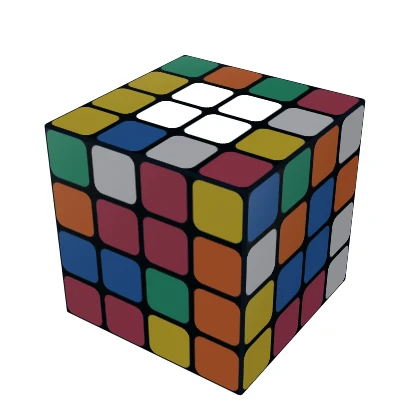
Second center
Turn the cube over so white is on the bottom, and build the yellow center on top the same way. From now on, every wide turn that moves the white center has to be undone right after, for example Rw U Rw' or Rw U2 Rw'.
Last four centers
Hold the cube with white and yellow on the left and right. Rw and U turns never move those two centers, so you can use them freely.
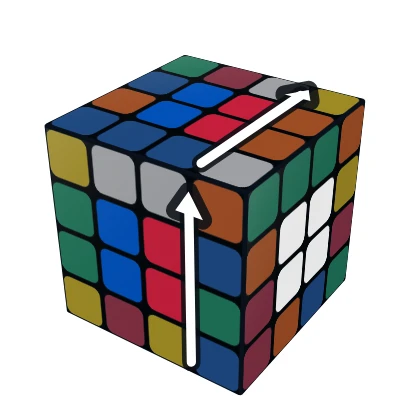
Mind the order of the colors. White is opposite yellow, blue opposite green and red opposite orange. With yellow on top and blue in front, red goes on the right, green at the back and orange on the left.
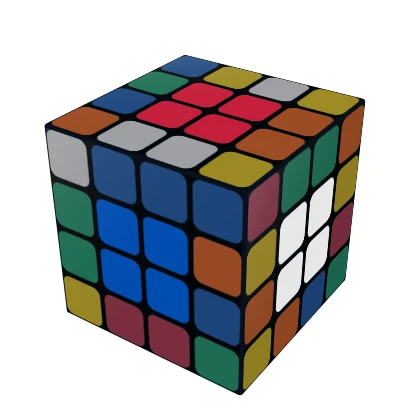
For the last two centers, hold them on top and in front so that each has a column of the other’s color, the top one on its left and the front one on its right. Rw U2 Rw' swaps those two columns and keeps the other four centers.
Check the colors
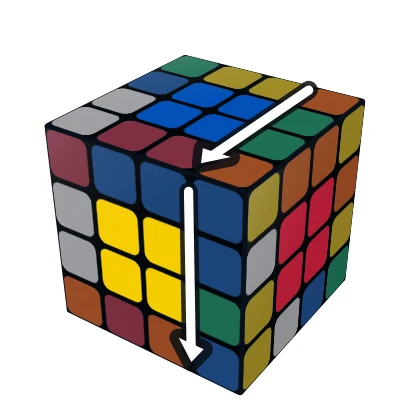
Because a 4x4 has no fixed centers, nothing stops you from putting two centers in the wrong places, and you’d only notice at the very end. Check them now against any corner: the three colors of a corner must match the three centers around it.
If two side centers are swapped, hold them on top and in front and do this. It swaps those two centers. Edges and corners move too, which doesn’t matter yet.
Rw' F2 Rw2 U2 Rw'
Step 2. Pair the edges
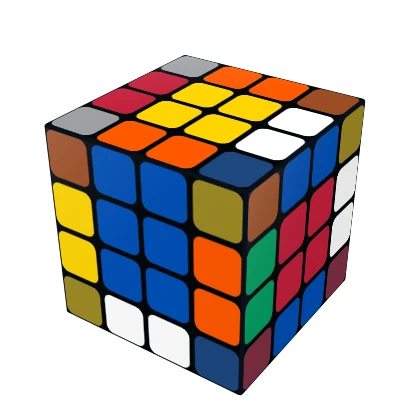
Each edge is made of two pieces with the same two colors. Pair them all up without breaking the centers. Outer-layer turns (R, L, U, D, F, B) never break the centers or a finished pair, so use them freely to move pieces around.
Pair an edge
Find two matching edge pieces. Put them in the top halves of the front-left and front-right edges, with the same color facing you. Then do:
Uw'·R U R' F R' F' R·Uw
Uw' brings the left piece over to the right edge. R U R' F R' F' R flips that edge so the piece goes to the bottom half. Uw brings the other piece back on top of it and puts the centers back.
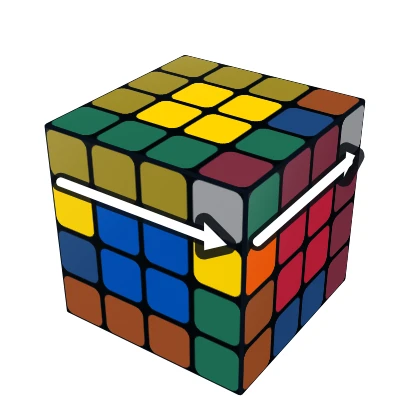
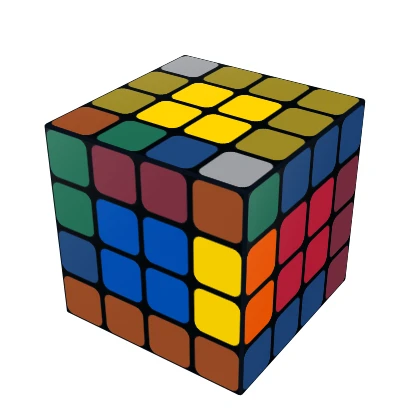
Only the front-left and front-right edges are split or joined; finished pairs anywhere else are safe. The piece that was in the bottom half on the right goes to the top half on the left, so you can often set up the next pair straight away.
If a piece is in the wrong half of its edge, R U R' F R' F' R on its own flips the front-right edge and swaps its top and bottom halves.
Last two edges
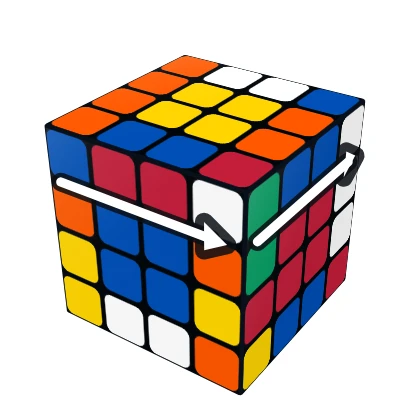
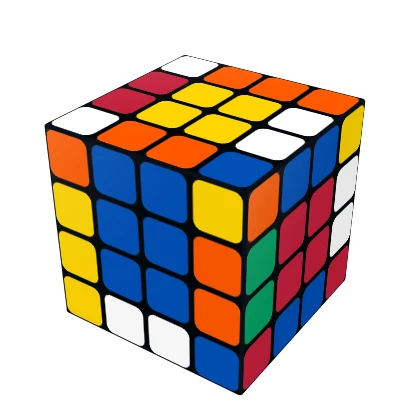
Put the last two unpaired edges at the front left and front right, so that the top halves match each other (same color facing you) and the bottom halves match each other. The same algorithm pairs both at once. If they don’t line up like that, flip the front-right edge with R U R' F R' F' R first.
Step 3. Solve it like a 3x3
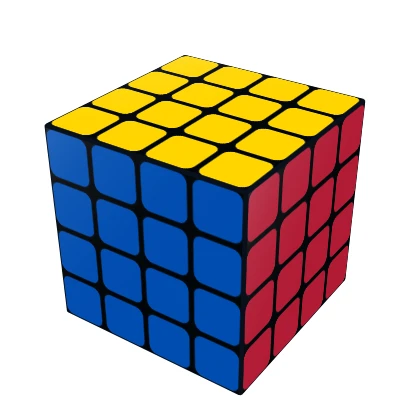
Treat each 2x2 center as one center and each pair as one edge, and solve the cube with the beginner method or CFOP. Use only outer-layer turns (R, U, F…) so the centers and pairs stay together.
The cross, the first two layers and the last layer work exactly as on a 3x3. Only two things can happen that never happen on a 3x3: a single edge flipped on its own, or two edges swapped on their own. That is parity. Don’t worry when you get it: about three solves in four have at least one of the two, and it doesn’t mean you did anything wrong.
Step 4. OLL parity and PLL parity
OLL parity: one flipped edge
While making the top yellow, you find a single edge flipped. For example three top edges have yellow up and one has yellow facing out, a shape that can’t happen on a 3x3. Hold that edge at the front and do:
2R2 B2 U2 2L U2 2R' U2 2R U2 F2 2R F2 2L' B2 2R2
It flips only that edge, then you carry on as usual.
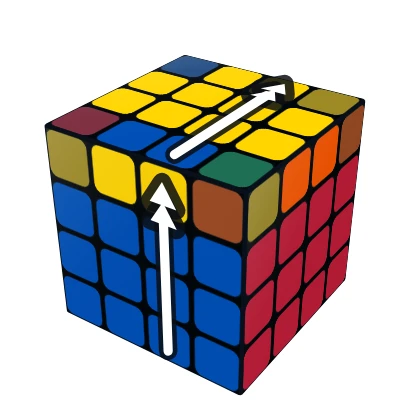
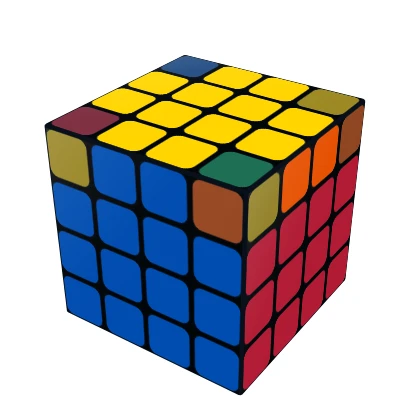
Many cubers use Rw U2 x Rw U2 Rw U2 Rw' U2 Lw U2 Rw' U2 Rw U2 Rw' U2 Rw' instead, which is quicker to turn. It flips the edge too, but it also moves other pieces of the top layer, so do it before you solve the rest of the top.
PLL parity: two edges swapped
At the last step, two edges across the top seem swapped, a case no 3x3 algorithm solves. Hold them at the front and back, then do:
2R2 U2 2R2 Uw2 2R2 Uw2
Then turn the top with U2. If the rest of the top isn’t solved yet, do the algorithm and then finish the top as usual.
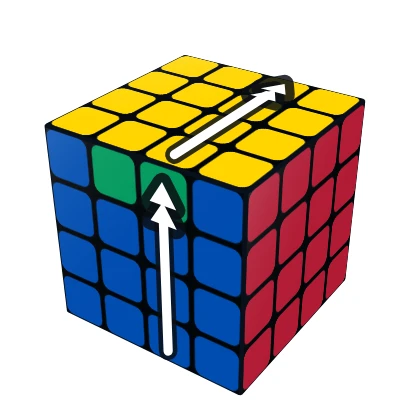
Turn only the second layer (2R2) in this algorithm. Turning both right layers together (Rw2) breaks the centers.
Each parity shows up in about half of all solves, on its own or together with the other. When you get both, fix the OLL parity first.
Common mistakes
- Centers in the wrong places. Check them against a corner before you pair the edges.
Rw2instead of2R2in the PLL parity. It breaks the centers.- Breaking a finished pair by bringing it back to the front-left or front-right while you pair the others.
- The faster OLL parity after solving the top. It moves other top pieces, so do it first.
How fast can you solve a 4x4?
A good time to aim for is about four times your 3x3 time. Once the reduction method feels easy, look up 3-2-3 edge pairing, which pairs three edges at a time, and the Yau method, which builds the white cross before the last four centers. Most fast 4x4 solvers use Yau.
If you’re stuck, scan your 4x4 with the app. It finds a solution of 69 moves on average for a random scramble, or about 52 with the Pro solver, and shows every move in 3D.
Next steps
- The 5x5 uses the same ideas, has fixed centers and no OLL or PLL parity.
- Learn 2-look OLL and PLL to make the 3x3 stage faster.
- Back to the guide overview.