
How to solve a 5x5 Rubik's Cube
Updated 2026-11-28 · by the Magic Cube team
A 5x5 is solved in four steps: build the six centers, pair the first eight edges, pair the last four, then solve it like a 3x3 with outer-layer turns. It uses the same edge-pairing algorithm as the 4x4, plus one algorithm for edge parity. Unlike the 4x4, it never has OLL or PLL parity.
If you can solve a 4x4, you already know most of this. If not, read the 4x4 guide first: the moves (Rw, 2R, Uw) and the pairing algorithm are explained there with more pictures.
What is on a 5x5
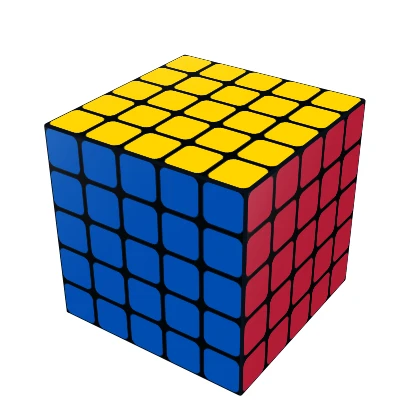
Each face has 9 center pieces: the fixed middle one, four next to it and four on its corners. These three kinds never mix: a corner-type center piece can only ever go to a corner spot. Each edge has three pieces: a middle one (the midge) and two wings.
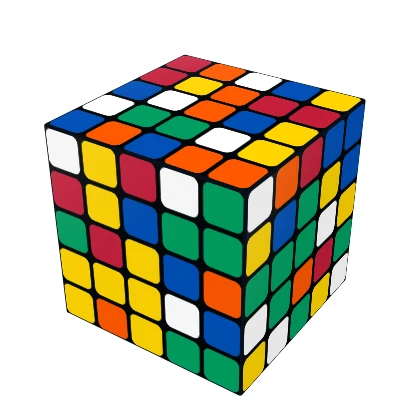
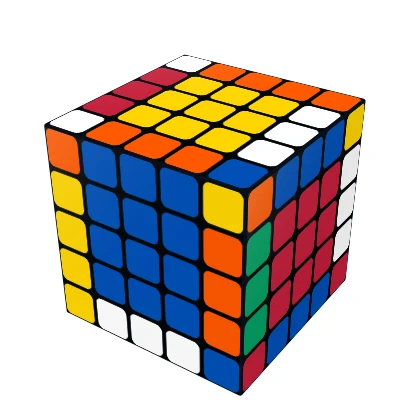
The fixed middle pieces decide the colors, so on a 5x5 you can’t put a center in the wrong place. That is the main thing that makes it friendlier than a 4x4.
Step 1. Centers
First center
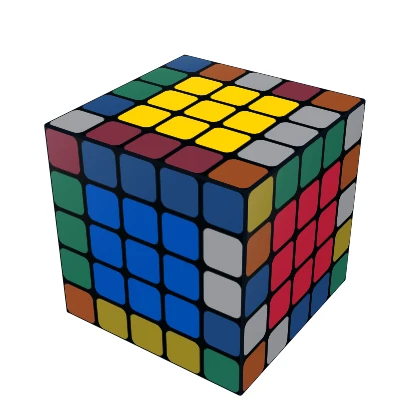
Hold white on top. First make the middle bar: bring white pieces next to the fixed white piece so there is a line of three across the face. Then build two more bars of three on other faces, and bring each one up beside the middle bar with a wide turn such as Rw, after turning the top so its spot is free.
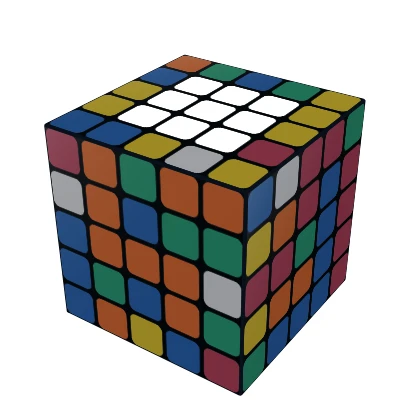
Second center
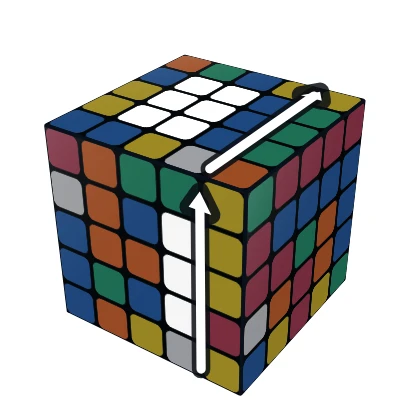
Turn the cube over, white on the bottom, and build yellow on top the same way. As on the 4x4, undo every wide turn that moves the white center right away, for example Rw U Rw'.
Last four centers
Hold the cube with white and yellow on the left and right. Turns of the right and left layers (R, Rw, 2R…) and of the top never move those two centers, so you can use them freely. Build the third center, then the fourth next to it.
For the last two, hold them on top and in front, build bars of three and move them across with Rw U2 Rw', just as on the 4x4.
Step 2. The first 8 edges
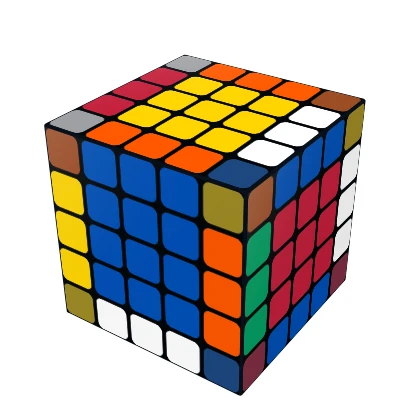
Each edge has three pieces that must match: the midge and two wings. A wing only fits one way next to its midge, so check both colors. Joined, the three are called a tredge (three-piece edge).
Pair an edge
Put the edge you are building at the front right, with its midge and top wing already together, and the missing wing at the top of the front-left edge. Then do the same algorithm as on the 4x4:
Uw'·R U R' F R' F' R·Uw
Uw' brings the wing over, R U R' F R' F' R flips the front-right edge so the wing drops to the bottom, and Uw puts the centers back.
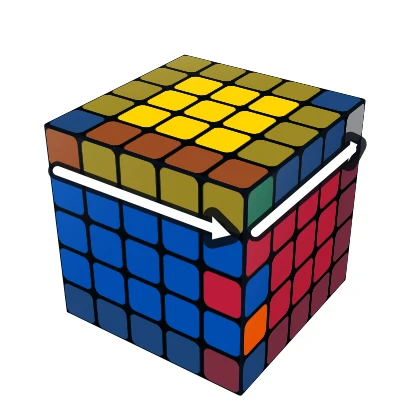
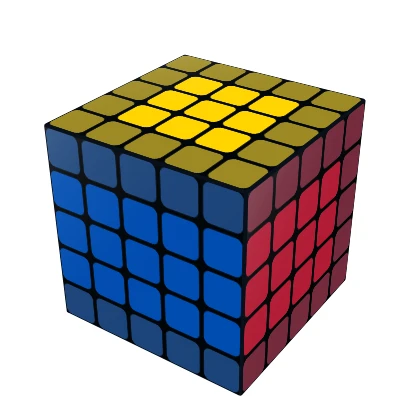
Only the front-left top wing and the front-right bottom wing trade places; every other finished edge stays whole. If a wing is on the wrong side, flip its edge with R U R' F R' F' R first. Keep finished edges in the top and bottom layers, out of the way.
When this feels easy, try freeslice: turn Uw once so the centers are off, keep finished edges in the top and bottom layers, and use the middle ring to build eight edges in a row before you turn the centers back. It saves undoing the slice after every edge.
Step 3. The last 4 edges
The last four edges are paired the same way, but now all the unpaired pieces are in each other’s way. Put two of them at the front left and front right so that the algorithm matches pieces up, and use outer turns and R U R' F R' F' R to line them up.
Pair as many as you can. The algorithm always swaps the front-left top wing with the front-right bottom wing, so look for an edge where one of those wings is already right.
Edge parity
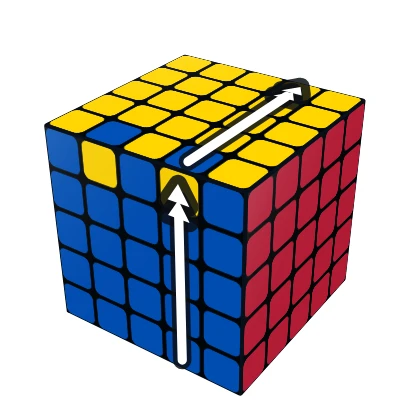
Sometimes the very last edge ends up with its midge right but its two wings swapped. No pairing move fixes that: it is the 5x5’s edge parity. Hold that edge at the front of the top layer and do:
2R2 B2 U2 2L U2 2R' U2 2R U2 F2 2R F2 2L' B2 2R2
It swaps the two wings of that edge and nothing else. It’s the same algorithm as the 4x4 OLL parity.
A faster version many cubers use is Rw U2 x Rw U2 Rw U2 3Rw' U2 Lw U2 Rw' U2 Rw U2 Rw' U2 Rw'. Mind the 3Rw': three layers turn there. It also moves a few pieces of the top layer, which you’ll solve in the 3x3 stage anyway.
Step 4. Solve it like a 3x3
With all centers and edges done, solve the cube like a 3x3 using outer turns only, with the beginner method or CFOP. The fixed centers keep everything where it belongs, so you will never see the OLL or PLL parity of the 4x4 here.
To get faster, learn freeslice for the edges, and later the Yau5 method, which builds the cross early like Yau on the 4x4.
If you’re stuck, scan your 5x5 with the app. It finds a solution of 102 moves on average for a random scramble, or about 79 with the Pro solver, and shows every move in 3D.
6x6, 7x7 and bigger
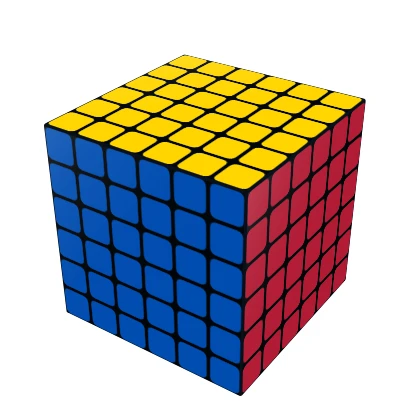
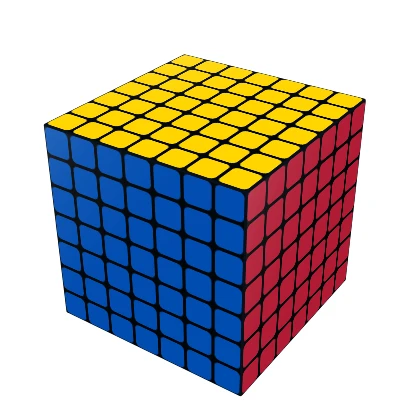
Every big cube is solved the same way: centers, then edges, then like a 3x3. A 6x6 has 16 center pieces per face and 4 pieces per edge, a 7x7 has 25 and 5. Even cubes (4x4, 6x6) work like the 4x4: no fixed centers, and OLL and PLL parity in the 3x3 stage. Odd cubes (5x5, 7x7) work like the 5x5: fixed centers, and parity only while pairing edges.
On bigger cubes a number says which layers turn: 3R turns only the third layer from the right, 3Rw the three right layers together. Learn them in order (4x4, 5x5, then 6x6 and 7x7), turn a little slower than on a 3x3, and a magnetic cube helps a lot. The app solves cubes up to 6x6 and has lessons for 6x6 and 7x7.
Next steps
- Make the 3x3 stage faster with 2-look OLL and PLL.
- Go back to the 4x4 if parity there still confuses you, or to the guide overview.